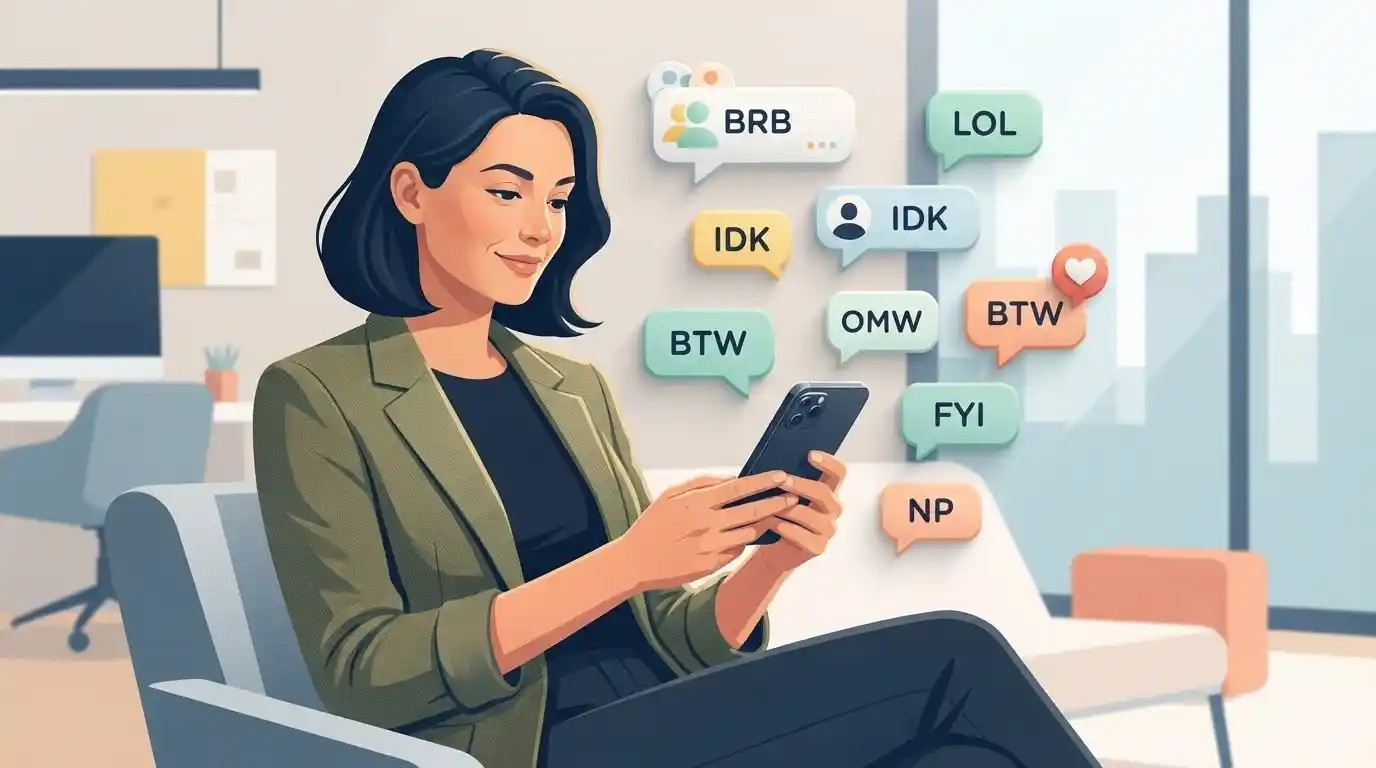
Internet abbreviations slang refers to shortened words, phrases, and acronyms people use in texts, chats, DMs, comments, and social media to communicate quickly. Common examples include LOL (“laughing out loud”), BRB (“be right back”), BTW (“by the way”), and IDK (“I don’t know”).
Key Takeaways
- Internet abbreviations are shortened forms of words or phrases used in online communication.
- They can include acronyms such as LOL, initialisms such as IDK, and shortened expressions such as pls or rn.
- Their meaning can depend on the conversation, punctuation, emojis, and relationship between the people chatting.
- Most are informal and work best in texts, DMs, group chats, comments, and casual social media conversations.
- Some abbreviations have multiple meanings, so context matters before assuming what someone means.
- Internet slang changes over time, while widely established abbreviations can remain common for years.
Internet Abbreviations Slang Meaning in Text
In texting, internet abbreviations slang means shortened language used to make online conversations faster, easier, or more casual. These expressions are a form of text slang, messaging shorthand, and social media language.
Instead of typing an entire phrase, someone may write OMG for “oh my God,” TBH for “to be honest,” or TTYL for “talk to you later.”
The term is broad rather than being one specific abbreviation. It describes a whole category of shortened online expressions.
Common Types of Internet Abbreviations
Acronyms: Formed from the initial letters of a phrase and commonly pronounced as a word or used as a letter-based abbreviation.
Example: LOL — “laughing out loud.”
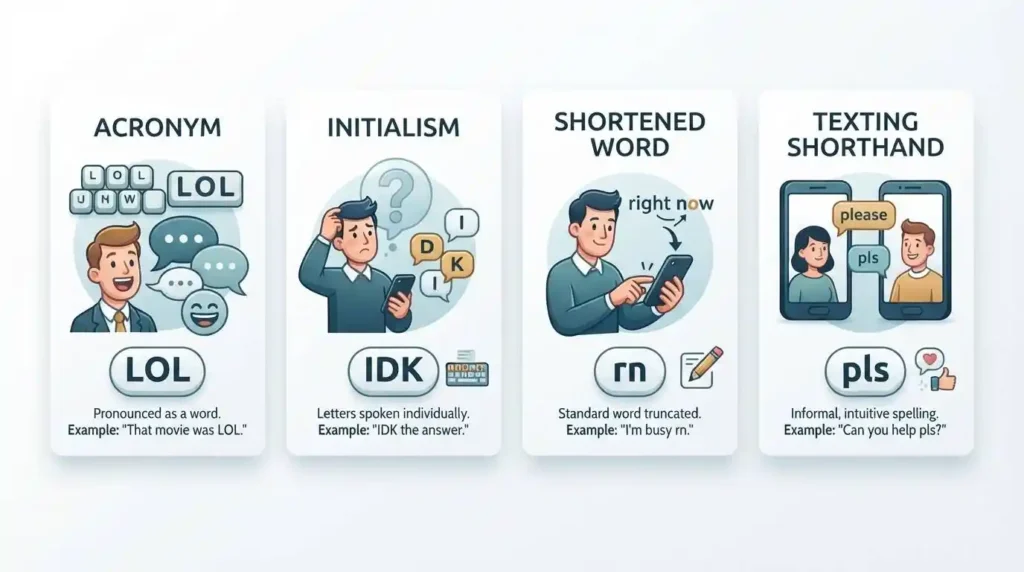
Initialisms: Made from the first letters of several words and normally pronounced letter by letter.
Example: IDK — “I don’t know.”
Shortened words: Words are reduced to make typing quicker.
Example: rn — “right now.”
Texting shorthand: Informal shortened expressions used in everyday messaging.
Example: u for “you” or pls for “please.”
Not every shortened expression fits perfectly into one category, and everyday internet users often use “abbreviation,” “acronym,” and “slang” interchangeably.
What Does Internet Abbreviations Slang Stand For?
Internet abbreviations slang does not have one fixed full form. It is a general term describing abbreviated or shortened language used online.
The individual abbreviations do have their own meanings. For example:
- LOL = laughing out loud
- IDK = I don’t know
- BTW = by the way
- BRB = be right back
- IMO = in my opinion
- TBH = to be honest
- OMG = oh my God
- FYI = for your information
- TTYL = talk to you later
- IRL = in real life
So, there is no single expansion for the phrase internet abbreviations slang itself.
How Is Internet Abbreviations Slang Used?
Internet abbreviations appear wherever people communicate informally online.
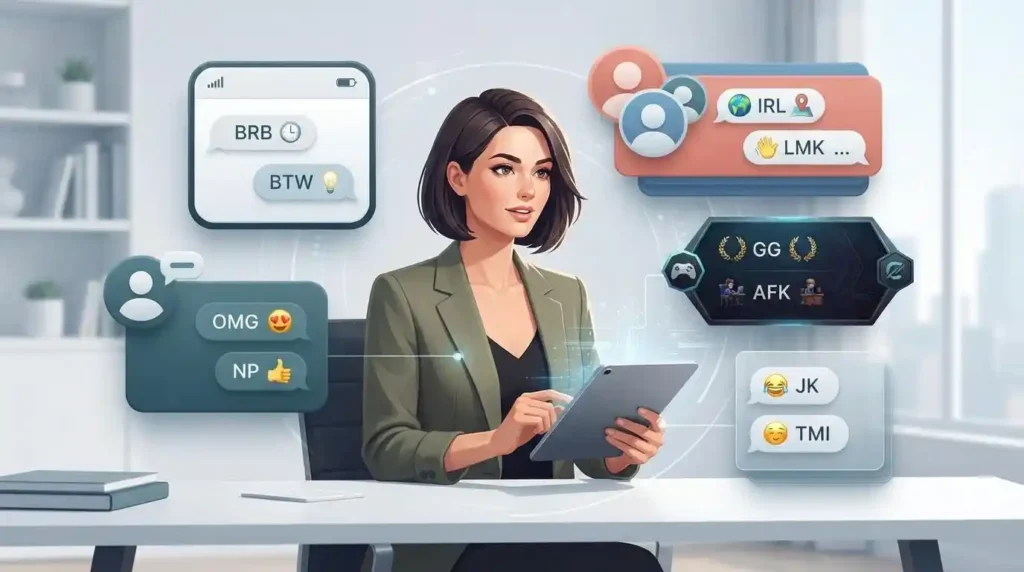
Text Messages
People use short forms to keep conversations quick.
“IDK what time I’ll be home.”
“BRB, someone’s calling me.”
DMs
Direct messages often contain abbreviations because they feel conversational and informal.
“TBH, that was really funny lol.”
Group Chats
Abbreviations can make fast-moving conversations easier to follow.
“BTW, are we still meeting at 7?”
Social Media Comments
Short forms are common in casual comments and replies.
“OMG this is so cute!”
Gaming
Gamers frequently use shorthand when speed matters.
“GG!”
“BRB, grabbing water.”
“AFK for a minute.”
The exact abbreviations people use can vary by community, age group, platform, and topic.
Internet Abbreviations Slang in Different Contexts
An abbreviation usually gets its meaning from the surrounding conversation. The same expression can also feel different depending on who sends it and why.
From a Friend
A friend might use LOL, OMG, or IDK casually without giving the message any special emotional meaning.
“LOL you actually did it.”
From a Guy or Girl
The abbreviation itself generally does not have a different meaning based on whether the sender is a guy or a girl.
The surrounding conversation matters more than the sender’s gender.
From a Crush
An abbreviation can appear in a flirtatious conversation, but the abbreviation alone does not prove romantic interest.
For example:
“LOL you’re actually funny.”
The meaning depends on the larger conversation, previous messages, emojis, and relationship between the people.
In Dating
Casual abbreviations can make messages feel relaxed.
“TBH I had a really good time tonight.”
That wording may be warm or personal, but the abbreviation TBH itself simply means “to be honest.”
In a Relationship
Partners may use familiar shorthand because they already understand each other’s communication style.
“OMW ❤️”
Here, OMW means “on my way”; the emoji and relationship provide additional context.
In a Group Chat
Abbreviations can make quick exchanges easier:
“FYI, the movie starts at 8.”
In Social Media Comments
The tone is often casual:
“OMG I love this!”
When interpreting an unfamiliar abbreviation, check the messages around it rather than relying only on the letters.
Real Chat Examples
Here are realistic examples showing how common internet abbreviations work in everyday conversations:
- “LOL that was hilarious.” — LOL = laughing out loud.
- “IDK what to watch tonight.” — IDK = I don’t know.
- “BRB, my food is here.” — BRB = be right back.
- “BTW, did you finish the assignment?” — BTW = by the way.
- “TBH, I liked the first movie better.” — TBH = to be honest.
- “OMG, look at this!” — OMG = oh my God.
- “FYI, the store closes at 9.” — FYI = for your information.
- “TTYL! I have to go.” — TTYL = talk to you later.
- “IMO, that’s the best option.” — IMO = in my opinion.
- “IRL, he’s much quieter.” — IRL = in real life.
- “OMW, see you soon.” — OMW = on my way.
- “RN I’m just relaxing.” — RN = right now.
- “AFK for five minutes.” — AFK = away from keyboard.
- “JK, I’m not actually mad.” — JK = just kidding.
- “NVM, I figured it out.” — NVM = never mind.
- “LMK when you get home.” — LMK = let me know.
- “WYD tonight?” — WYD = what are you doing?
- “HBU?” — HBU = how about you?
- “NP, happy to help.” — NP = no problem.
- “TYSM for helping me!” — TYSM = thank you so much.
- “G2G, talk later.” — G2G = got to go.
- “DM me the details.” — DM = direct message.
- “That outfit is fire, NGL.” — NGL = not gonna lie.
- “I’ll be there ASAP.” — ASAP = as soon as possible.
How to Reply to Internet Abbreviations Slang
Because internet abbreviations cover many different expressions, the best reply depends on the specific abbreviation and conversation.
Casual Replies
For something like “BTW, are you coming?”, you could say:
- “Yep, I’ll be there.”
- “Yeah, probably!”
- “I think so.”
Friendly Replies
If someone says:
“TYSM!”
You can reply:
- “You’re welcome!”
- “Of course!”
- “Anytime!”
Funny Replies
If a friend says:
“LOL that was so embarrassing.”
You could respond:
- “You survived 😂”
- “I’m never letting you forget that.”
- “Still thinking about it 😂”
Neutral Replies
If you are unsure what someone means, ask directly:
- “What does that mean?”
- “What do you mean by that?”
- “Can you clarify?”
Flirty/Relationship Replies
If an abbreviation appears in a romantic conversation, respond to the overall message, not just the abbreviation.
For example, if someone says:
“TBH, I really enjoyed hanging out with you.”
A natural response could be:
- “Same, I had a great time.”
- “I’m glad! I enjoyed it too.”
- “That’s nice to hear 😊”
The abbreviation TBH does not itself make the message romantic.
What Tone Does Internet Abbreviations Slang Have?
Internet abbreviations are generally casual and informal. Depending on the expression, they can also sound:
- Friendly
- Playful
- Relaxed
- Direct
- Humorous
- Neutral
- Sarcastic
- Context-dependent
For example, LOL can show amusement, but it can also soften a statement or simply match a casual texting style.
Punctuation and emojis can also affect how a message feels. Compare:
“LOL”
with:
“LOL 😂”
or:
“LOL.”
The words are similar, but the surrounding style can change the perceived tone.
Is Internet Abbreviations Slang Rude or Offensive?
Internet abbreviations are not automatically rude or offensive. Most common texting abbreviations are simply informal shorthand.
They are generally suitable for:
- Texting friends
- Casual group chats
- DMs
- Informal social media conversations
- Casual online communities
They may be less appropriate for:
- School assignments
- Professional emails
- Job applications
- Formal business communication
- Academic writing
For example, writing “IDK” to a friend is normal casual communication, while writing “IDK” in a formal school paper would usually be inappropriate.
Some individual internet abbreviations can contain profanity or offensive language, so their appropriateness must be judged separately from ordinary shorthand.
Other Meanings of Internet Abbreviations Slang
Because internet abbreviations slang is a broad category rather than one abbreviation, it does not have one standard alternative meaning.
However, individual abbreviations can be ambiguous.
For example, AFK commonly means “away from keyboard” in online communication, while an abbreviation used in another field may have a completely different expansion.
Likewise, DM can mean “direct message” on social platforms, while “DM” can have other meanings in professional or technical contexts.
This is why the surrounding subject matters when interpreting an unfamiliar abbreviation.
Common Mistakes About Internet Abbreviations Slang
Assuming Every Abbreviation Has One Meaning
Some abbreviations have multiple interpretations. The conversation provides important clues.
Treating Slang as Formal Language
Texting shorthand is designed for informal communication. It does not automatically belong in formal writing.
Assuming an Abbreviation Shows Romantic Interest
A person using LOL, TBH, OMG, or another casual abbreviation is not necessarily flirting. Look at the complete message and conversation.
Confusing Similar Abbreviations
Some abbreviations look alike or are easy to mix up. For example, IMO means “in my opinion,” while IMHO means “in my humble opinion.”
Ignoring Context
An abbreviation can mean something different in gaming, technology, business, social media, or everyday texting. Context should come first.
Internet Abbreviations Slang and Related Slang
| Term | Meaning | Common Use |
|---|---|---|
| LOL | Laughing out loud | Showing amusement |
| IDK | I don’t know | Expressing uncertainty |
| BTW | By the way | Adding another point |
| BRB | Be right back | Temporarily leaving a chat |
| TBH | To be honest | Introducing an honest opinion |
| NGL | Not gonna lie | Emphasizing honesty |
| LMK | Let me know | Asking someone to provide information |
| TTYL | Talk to you later | Ending a conversation temporarily |
| OMW | On my way | Saying you are traveling to a place |
| RN | Right now | Referring to the current moment |
| WYD | What are you doing? | Asking about someone’s activity |
| HBU | How about you? | Returning a question |
| NVM | Never mind | Withdrawing or dismissing a previous point |
| JK | Just kidding | Indicating something was a joke |
| AFK | Away from keyboard | Indicating temporary absence online |
People Also Ask About Internet Abbreviations Slang
What is an internet abbreviation?
An internet abbreviation is a shortened word or phrase used in online communication. Examples include LOL, IDK, BRB, and BTW.
What is the difference between slang and an abbreviation?
An abbreviation shortens a word or phrase, while slang is informal language associated with casual communication or particular communities. The two can overlap, which is why shortened expressions are often described as internet slang.
Why do people use abbreviations in texting?
They can make messages quicker to type and help conversations feel casual and conversational. Their usefulness depends on whether the person receiving the message understands the abbreviation.
Are internet abbreviations appropriate for school or work?
Common abbreviations are usually fine in casual messages with friends or coworkers when the setting is informal. Formal assignments, professional emails, applications, and official documents generally call for standard language instead.
Can one internet abbreviation have different meanings?
Yes. Some abbreviations have more than one possible interpretation, especially when they are used across different communities or industries. The topic and surrounding messages can help determine the intended meaning.
How can I understand an abbreviation I have never seen?
Look at the sentence around it and consider the conversation topic. If the meaning is still unclear, the simplest approach is to ask the sender what they mean.
Does using an internet abbreviation mean someone is being informal?
Usually, yes. Abbreviations such as LOL, IDK, and BRB are strongly associated with casual digital communication, although some have become familiar enough that people recognize them immediately.
Conclusion
Internet abbreviations slang is a broad term for shortened language used in texting, DMs, group chats, comments, gaming, and other online conversations. It has no single full form because it describes a category of expressions rather than one abbreviation.
Common examples include LOL, IDK, BTW, BRB, TBH, OMG, and TTYL. Their tone is usually casual and informal, but context matters when interpreting meaning or emotional intent. For formal school, business, or professional writing, standard words are usually the safer choice.

Christopher Hayes is a writer focused on captions and quotes that capture moments, moods, and personal expressions. Over five years, he has worked across travel, lifestyle, relationships, events, social media, entertainment, and aesthetic themes. Christopher studies caption styles, refines wording choices, and structures short-form phrases to create clear, memorable lines suited to different occasions.