IDM usually means “I Don’t Mind” in text messages, chats, and social media. It is a casual way to say that you are okay with something, have no strong preference, or are comfortable with someone’s choice.
Key Takeaways
- IDM most commonly means “I Don’t Mind.”
- It is a texting abbreviation used to express acceptance or a lack of preference.
- The meaning is usually casual, neutral, and context-dependent.
- You may see IDM in text messages, DMs, group chats, and online conversations.
- “I don’t mind” can sound positive, neutral, or slightly indifferent depending on the conversation.
- IDM should generally be avoided in formal writing unless the abbreviation is already understood by everyone involved.
IDM Meaning in Text
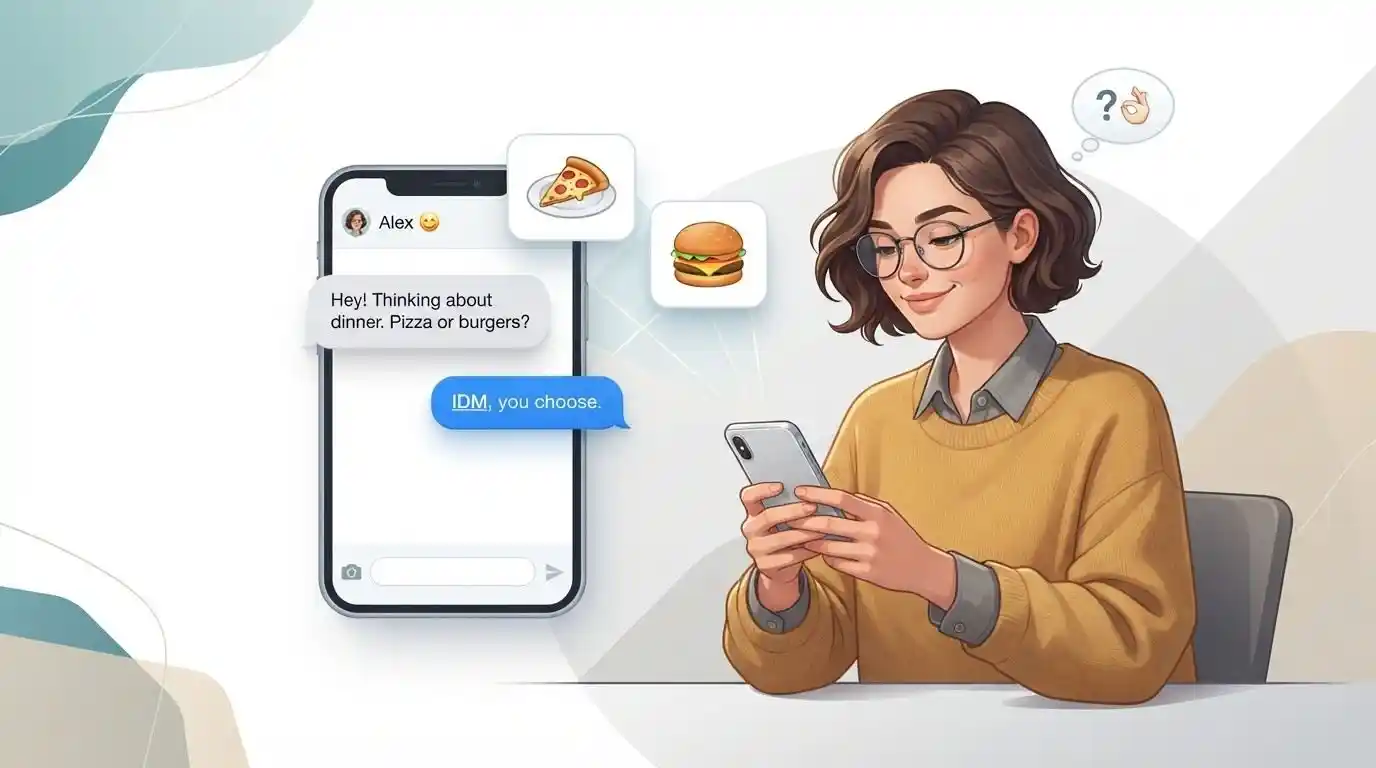
In texting, IDM means “I Don’t Mind.” Someone uses it when they are okay with a suggestion, choice, plan, or situation.
For example:
“Do you want pizza or burgers?”
“IDM, you choose.”
Here, the person is saying they have no strong preference and are happy to let the other person decide.
IDM is a form of text slang and messaging shorthand. It helps people express a simple idea quickly without typing the full phrase.
The tone is usually casual and neutral, although the exact feeling depends on the surrounding conversation.
What Does IDM Stand For?
IDM stands for “I Don’t Mind.”
It is a shortened form of the phrase rather than a technical term. In online communication, people may type IDM instead of writing the complete sentence.
The phrase generally communicates:
- I am okay with it.
- Either choice works for me.
- It does not bother me.
- You can decide.
- I have no preference.
How Is IDM Used?
IDM is mainly used in informal online communication where short, quick messages are common.
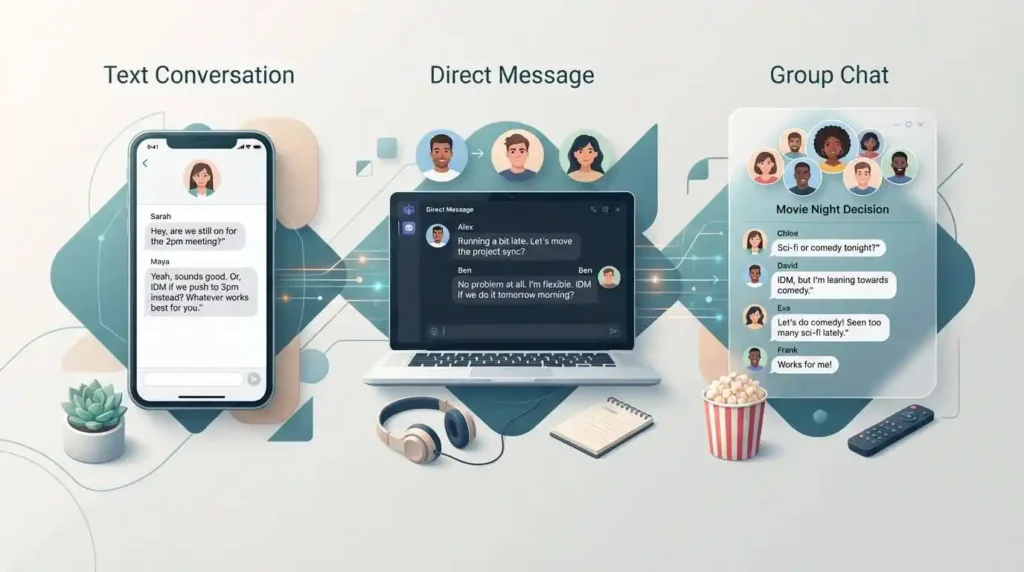
Text Messages
A friend might ask:
“Can I call you later?”
You could reply:
“IDM.”
This means you are okay with the call.
DMs
In a direct message, IDM can show that you are comfortable with a suggestion:
“We could meet around 6 instead.”
“IDM, that works.”
Group Chats
IDM can also help settle a group decision:
“Should we watch a movie or play a game?”
“IDM, whatever everyone wants.”
Social Media
You may occasionally see IDM in comments or casual conversations when someone wants to say that something does not bother them or that they have no preference.
IDM in Different Contexts
The basic meaning stays the same, but the tone can change depending on context.
From a Friend
If a friend says, “IDM, you pick,” they probably mean they are happy for you to make the decision.
From a Guy or Girl
IDM does not have a different definition based on whether the sender is a guy or a girl. The surrounding conversation matters more than the sender’s gender.
From a Crush
If someone you like says “IDM,” the abbreviation by itself does not prove romantic interest or disinterest. Look at the broader conversation, wording, and situation.
In Dating
A dating conversation, IDM can simply mean that someone is flexible about a plan.
“Want to get coffee or grab lunch?”
“IDM, both sound good.”
A Relationship
A partner might use IDM when they genuinely do not have a preference:
“IDM where we go for dinner.”
However, context can matter. A very short “idk, idm” response may feel less engaged than a detailed response, but the abbreviation alone does not establish someone’s attitude.
In a Group Chat
IDM can mean the sender is leaving a decision open to the group:
“IDM, just let me know what you guys decide.”
In Social Media Comments
In a casual comment, IDM can communicate that the person is not bothered by something or does not care which option is chosen.
Real Chat Examples
Here are realistic examples of how IDM can appear in everyday conversations:
- “IDM, you can choose the restaurant.”
- “Do you want to go Friday?” — “IDM.”
- “IDM if we leave a little later.”
- “Pizza or tacos?” — “IDM, both are good.”
- “Can we watch the second movie instead?” — “IDM.”
- “IDM what time we meet.”
- “Do you mind if I bring my friend?” — “IDM.”
- “IDM, whatever works for everyone.”
- “Would you rather sit inside or outside?” — “IDM.”
- “IDM if you want to change the plan.”
- “Which color should we get?” — “IDM, pick your favorite.”
- “Can we play something else?” — “IDM.”
- “IDM staying home tonight.”
- “Do you want coffee or tea?” — “IDM.”
- “IDM if we take the earlier train.”
- “Should we meet at 5 or 6?” — “IDM, either works.”
- “IDM, just tell me what you decide.”
- “Would it bother you if I invited Sam?” — “IDM.”
- “IDM going with your plan.”
- “IDM, I’m free either way.”
How to Reply to IDM
Your response depends on what the person means in the conversation.
Casual Replies
- “Cool, let’s do that.”
- “Sounds good!”
- “Okay, works for me too.”
- “Perfect.”
Friendly Replies
- “Awesome, I’ll pick then.”
- “Thanks for being flexible!”
- “Great, let’s go with my idea.”
- “Nice, that makes it easy.”
Funny Replies
- “So I get to make the executive decision? 😂”
- “Alright, my choice it is.”
- “You just handed me all the power 😂”
- “Okay, don’t blame me later!”
Neutral Replies
- “Okay, either works for you?”
- “Got it.”
- “Sounds good.”
- “I’ll let you know.”
Flirty/Relationship Replies
When the conversation is already romantic, you can make the response warmer:
- “Then I’ll pick somewhere fun for us 😊”
- “Good, I’ve got a plan.”
- “Perfect, I’ll surprise you.”
- “Then you’re trusting my choice 😉”
IDM itself does not automatically make a conversation romantic. The surrounding messages determine whether a flirty reply makes sense.
What Tone Does IDM Have?
IDM usually has a casual, neutral, and flexible tone.
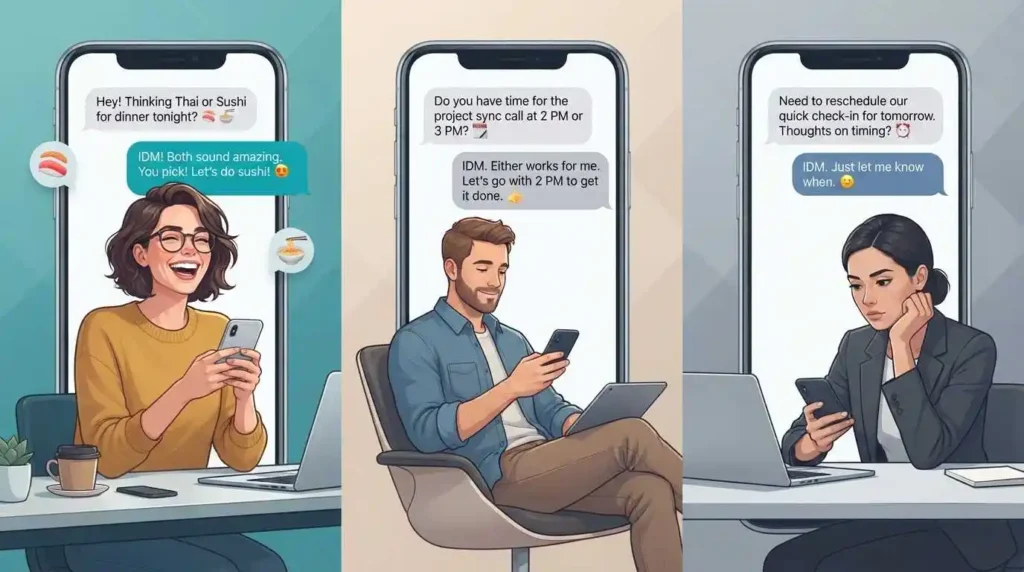
Depending on context, it can communicate:
- Casual: “IDM, let’s go later.”
- Friendly: “IDM, you choose.”
- Neutral: “IDM which one we get.”
- Direct: “IDM, either works.”
- Indifferent: “IDM.”
The punctuation and surrounding words can affect how a short response feels. For example, “IDM, you choose!” may sound more upbeat than simply “idm.”
Is IDM Rude or Offensive?
IDM is not inherently rude or offensive. It is a casual abbreviation for “I Don’t Mind.”
It is generally suitable for:
- Text messages
- Friends
- Casual group chats
- DMs
- Informal social media conversations
For school assignments, workplace messages, business communication, or formal writing, spelling out “I don’t mind” is usually clearer and more appropriate.
Also, IDM can sometimes sound indifferent if the conversation calls for a more enthusiastic answer. For example:
“Do you want to come to my party?”
A simple “IDM” may sound less enthusiastic than:
“Sure, I’d love to!”
That difference comes from the context, not from a separate meaning of IDM.
Other Meanings of IDM
“I Don’t Mind” is the relevant meaning when IDM appears in casual texting or chat. However, IDM can also be an abbreviation for unrelated terms in specialized fields.
For example, in technology, IDM can refer to Internet Download Manager, a software application associated with downloading files.
This is different from the texting abbreviation. Context is the key:
“IDM, you choose.” → I Don’t Mind
“I installed IDM for downloads.” → Internet Download Manager
The surrounding words usually make the intended meaning clear.
Common Mistakes About IDM
Assuming IDM Always Means “I Don’t Mind”
In a casual text, “I Don’t Mind” is usually the intended interpretation, but specialized conversations can use IDM differently.
Reading Too Much Into a Short Reply
“IDM” generally means the person has no objection or preference. It does not automatically mean they are annoyed, uninterested, flirting, or being dismissive.
Assuming IDM Means “I Don’t Care”
“I don’t mind” and “I don’t care” can overlap, but they are not always identical.
IDM often suggests that something is acceptable, while “I don’t care” can sometimes sound stronger or more dismissive.
Using IDM in Formal Writing
IDM works best in casual digital communication. In formal situations, writing the full phrase is clearer.
IDM and Related Slang
| Term | Meaning | Common Use |
|---|---|---|
| IDM | I Don’t Mind | Showing no preference or objection |
| IDC | I Don’t Care | Showing that something is not important to you |
| IDK | I Don’t Know | Saying you do not know the answer |
| IK | I Know | Showing that you already know something |
| NVM | Never Mind | Dropping or correcting a previous point |
The closest comparison is IDC, but the tone can differ. “IDM” usually says something is acceptable, while “IDC” can sound more indifferent depending on context.
People Also Ask About IDM
What does IDM mean in texting?
IDM usually means “I Don’t Mind.” It tells the other person that you are okay with something or do not have a strong preference.
What does IDM mean from a girl?
If a girl sends “IDM,” it normally means “I Don’t Mind,” just as it does from anyone else. Her gender does not change the abbreviation’s standard texting meaning.
What does IDM mean from a guy?
From a guy, IDM generally means “I Don’t Mind.” The exact tone depends on the conversation rather than the sender’s gender.
Does IDM mean “I don’t care”?
Not exactly. “I Don’t Mind” usually means something is acceptable or does not bother you, while “I don’t care” can communicate stronger indifference.
Is IDM a slang word?
IDM is better described as a texting abbreviation or messaging shorthand. It is commonly used in informal digital conversations rather than formal writing.
Can IDM have a different meaning?
Yes. In specialized contexts, IDM can stand for other terms, including Internet Download Manager. In ordinary texting, however, “I Don’t Mind” is the relevant interpretation.
Is IDM appropriate for school or work?
It depends on the situation. IDM is fine in an informal message to someone you know, but spelling out “I don’t mind” is safer for formal school or professional communication.
Conclusion
IDM in text usually means “I Don’t Mind.” It is an informal texting abbreviation used to show that something is acceptable, does not bother you, or is not a strong preference.
The tone is generally casual and neutral, although a very short “IDM” can sometimes sound indifferent depending on the conversation. In texting, DMs, and group chats, context helps determine the exact feeling. In specialized technology discussions, IDM can also mean Internet Download Manager, so the surrounding words matter.

Mila Parker is a writer focused on captions and quotes that capture experiences, emotions, and memorable moments. Her three years of work include creating material around travel, lifestyle, relationships, events, social media, entertainment, and aesthetic themes. Mila examines tone, refines phrasing, and structures captions to suit different contexts, occasions, and visual styles.