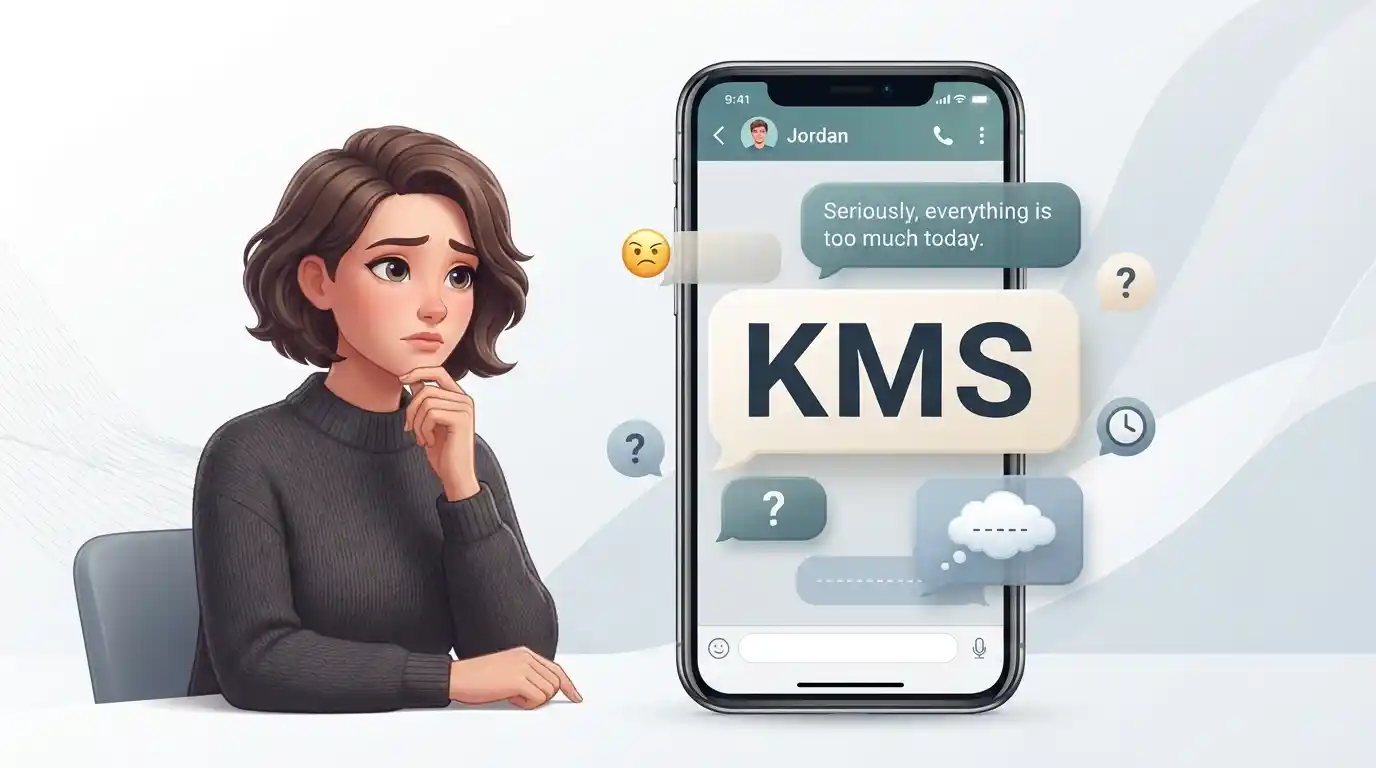
KMS usually means “kill myself” in text and online slang. It can be used as a dark joke or exaggeration, but when someone appears serious or distressed, their message should be taken seriously and responded to with care.
Key Takeaways
- KMS most commonly stands for “kill myself” in texting and online communication.
- It is often used informally as exaggerated or dark humor, depending on context.
- The abbreviation can also appear in messages expressing genuine emotional distress.
- Context, wording, emojis, and the surrounding conversation can change how it should be understood.
- Avoid assuming it is always a joke, especially if the person seems upset or serious.
- KMS is not appropriate for professional or formal communication.
KMS Meaning in Text
In text slang, KMS is an abbreviation for “kill myself.” People may use it in text messages, DMs, group chats, comments, and other online conversations.
The meaning and seriousness can vary widely. Sometimes a person uses KMS as dramatic exaggeration after an embarrassing, frustrating, or awkward moment. For example, someone might use it jokingly after making a small mistake.
However, the phrase can also signal genuine distress. Because the abbreviation refers to self-harm, it is important not to automatically dismiss a serious-sounding message as internet slang or a joke.
KMS is informal messaging shorthand and is generally unsuitable for school assignments, work communication, or formal writing.
What Does KMS Stand For?
KMS stands for “kill myself.”
It is a texting abbreviation made from the first letters of the phrase. In online communication, people may use it as shorthand instead of writing out the full phrase.
Although it is sometimes used casually or sarcastically, the abbreviation still refers to a serious subject. Its meaning should always be interpreted alongside the rest of the conversation.
How Is KMS Used?
KMS may appear in several types of online communication, including:
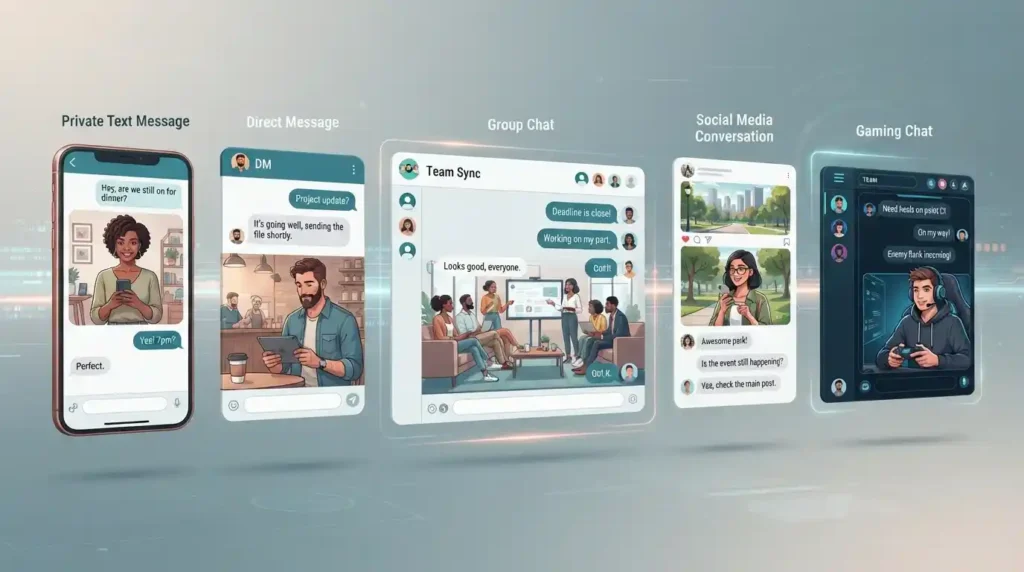
- Text messages
- Direct messages
- Group chats
- Social media posts
- Social media comments
- Online communities
- Gaming chats
A person might use it as exaggerated frustration, dark humor, or an expression of serious emotional distress. The surrounding conversation matters.
For example, a message about a minor inconvenience may have a different tone from a message that includes hopelessness, isolation, or other signs that someone is struggling.
KMS in Different Contexts
From a Friend
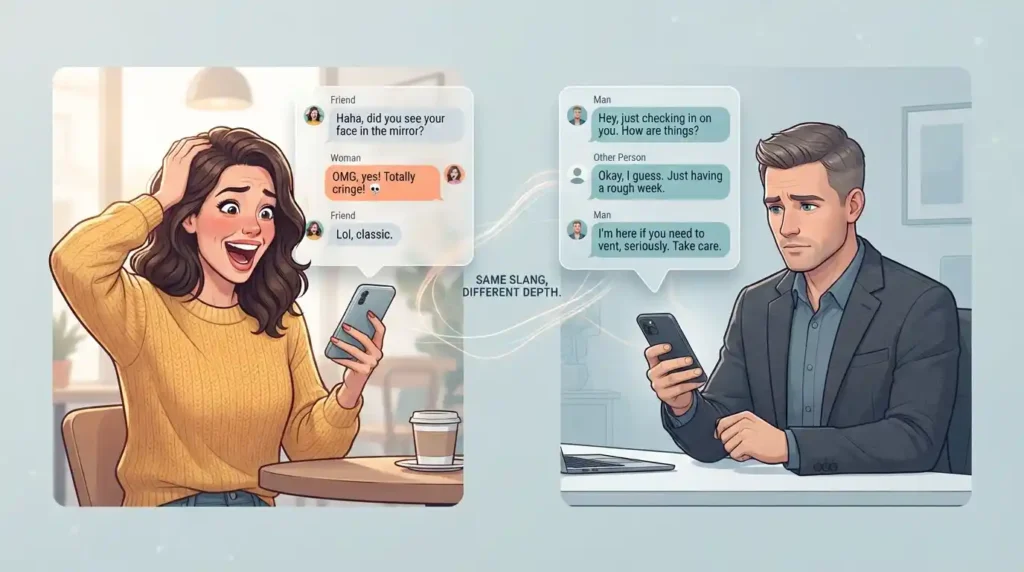
If a friend says KMS after something small and clearly jokes about an embarrassing moment, they may be using exaggerated internet slang. Even then, context matters.
If they seem unusually upset, withdrawn, or serious, check in with them directly and let a trusted adult know if you are concerned about their safety.
In a Group Chat
In a group chat, people sometimes use KMS as dramatic shorthand or dark humor. The casual setting does not guarantee that the person is joking, though.
Pay attention to whether the conversation suddenly becomes serious or whether the person continues expressing distress.
On Social Media
KMS can appear in captions, comments, posts, or replies. Online tone can be difficult to read, especially without hearing the person’s voice or knowing what is happening in their life.
Avoid making assumptions based only on the abbreviation.
In Dating or Relationship Conversations
KMS does not have a special romantic meaning. It does not automatically indicate flirting, rejection, jealousy, or attraction.
As with other conversations, the meaning depends on the surrounding messages and the person’s emotional state.
Real Chat Examples
Here are examples showing how KMS may appear in online communication. These examples focus on context without treating serious language as entertainment.
- “I sent that message to the wrong group chat 😭 kms.”
- “I forgot about the assignment until this morning. kms.”
- “That was so embarrassing, I can’t believe I said that 😭.”
- “My team lost again. I’m so frustrated.”
- “I made the same mistake twice today 😭 kms.”
- “Please don’t use KMS like that if you’re actually having a hard time.”
- “Are you joking, or are you seriously upset right now?”
- “Hey, I’m checking in because your message worried me.”
- “If you mean that seriously, please talk to someone you trust.”
- “That comment really upset me, and I need some support.”
- “I’m having a rough day and don’t want to be alone right now.”
- “I know you might be joking, but I just wanted to make sure you’re okay.”
- “You seem really overwhelmed. Want to talk about what’s going on?”
- “Let’s take this seriously for a second. Are you safe right now?”
- “I’m here with you, and we can find someone to help.”
The last several examples show why context matters. If someone appears to be expressing real distress, responding with care is more important than treating the message as ordinary slang.
How to Reply to KMS
Your reply should depend on the context.
Casual Replies
If the person is clearly making a harmless exaggeration about a minor situation, you can respond to the situation without repeating or encouraging the phrase.
- “That was definitely awkward 😭.”
- “Oh no, that’s embarrassing.”
- “You’ll survive that one 😂.”
- “Okay, that mistake was rough.”
Friendly Check-In Replies
If you are unsure whether the person is joking:
- “Hey, are you okay?”
- “Do you mean that seriously?”
- “Just checking in because that message worried me.”
- “I’m here if you want to talk.”
Serious-Sounding Situations
If someone appears to be genuinely in danger or says they may hurt themselves, do not handle it alone. Stay with the conversation if you can, contact a trusted adult or another responsible person nearby, and seek immediate emergency help when there is an urgent risk.
It is better to take a concerning message seriously than to assume it was only a joke.
What Tone Does KMS Have?
KMS can have different tones depending on context, including:
- Informal
- Exaggerated
- Sarcastic
- Darkly humorous
- Frustrated
- Distressed or serious
The abbreviation itself does not tell you which tone is intended. Previous messages, punctuation, emojis, the topic, and the person’s behavior can all provide context.
Is KMS Rude or Offensive?
KMS is not appropriate for many situations because it refers to self-harm.
Casual Conversations
Some people use it casually as exaggerated slang, but others may find it upsetting or insensitive.
Friends and Group Chats
Even among friends, it can be misunderstood. A joke may not land the same way for everyone, particularly if someone has personal experience with mental health struggles or self-harm.
Social Media
The abbreviation may be used online, but public posts can make tone especially difficult to interpret.
School and Work
KMS should generally be avoided in school, workplace, professional, or formal communication.
Other Meanings of KMS
Outside texting slang, KMS can have other meanings in specific fields, but those meanings depend heavily on context.
For example, KMS may refer to technical systems or services in computing and business environments. These uses are separate from the texting meaning and are usually clear from the topic of the conversation.
If you see KMS in a technical document, workplace discussion, or software-related conversation, do not automatically assume it means the texting slang.
Common Mistakes About KMS
Assuming It Is Always a Joke
Some people use KMS as exaggeration, but not every use is humorous. Take the person’s overall message and emotional state seriously.
Assuming It Is Always Serious
The abbreviation is also used as dark or dramatic internet slang. Context is necessary to understand the intended tone.
Ignoring the Surrounding Conversation
A few letters alone may not explain what someone means. Read the messages before and after it.
Treating It as a Romantic Signal
KMS does not indicate flirting, attraction, or relationship interest by itself.
Using It in Professional Communication
Because of its serious meaning and informal nature, it is best avoided in work, school, and formal settings.
KMS and Related Slang
| Term | Meaning | Common Use |
|---|---|---|
| KYS | A related abbreviation referring to the same harmful phrase directed at another person | Online slang; offensive and potentially harmful |
| IKR | “I know, right?” | Casual agreement in texting |
| SMH | “Shaking my head” | Frustration or disbelief |
| FML | A phrase expressing strong frustration or disappointment | Informal online slang |
Unlike ordinary expressions of frustration such as SMH, KMS refers to self-harm and should be interpreted more carefully.
People Also Ask About KMS
Is KMS always a joke?
No. Some people use KMS as exaggerated or dark humor, but others may use it while expressing genuine emotional distress. Context and the person’s overall messages are important.
What does KMS mean on Snapchat or social media?
The meaning is generally the same as in texting: “kill myself.” The platform does not change the core meaning, but the tone may depend on the conversation or post.
What should I do if someone says KMS and seems serious?
Check on them and take the message seriously. If you believe they may be in immediate danger, involve a trusted adult or responsible person and seek emergency help right away.
Is KMS appropriate to use with friends?
Some friend groups use it as dark humor or exaggeration, but it can be upsetting, misunderstood, or concerning. It is worth considering how others may interpret it.
Does KMS have a different meaning in technology?
Yes. In technical contexts, KMS can refer to systems or services with unrelated meanings. The surrounding topic usually makes the intended meaning clear.
Does KMS mean someone is flirting?
No. KMS is not a flirting abbreviation and does not indicate romantic interest by itself.
Conclusion
KMS meaning in text usually refers to “kill myself.” It is an informal abbreviation that may be used as exaggerated internet slang, but it can also appear in messages expressing genuine distress.
Context is essential when interpreting it. Look at the surrounding conversation, tone, and the person’s emotional state rather than assuming every use is a joke. Because the term relates to self-harm, it is best avoided in professional settings and taken seriously when someone appears to be struggling.

Mila Parker is a writer focused on captions and quotes that capture experiences, emotions, and memorable moments. Her three years of work include creating material around travel, lifestyle, relationships, events, social media, entertainment, and aesthetic themes. Mila examines tone, refines phrasing, and structures captions to suit different contexts, occasions, and visual styles.