
Strong reactions in text usually means intense emotional responses to something, such as shock, excitement, anger, surprise, or strong approval. It is a regular English phrase, not a texting acronym, and its exact meaning depends on the conversation and situation.
Key Takeaways
- Strong reactions refers to powerful emotional or physical responses.
- It is not a traditional acronym or texting abbreviation.
- In texts and social media, it often describes how strongly someone responds to a post, message, event, or opinion.
- The phrase can refer to positive, negative, or mixed emotions.
- Context determines which specific reaction is being discussed.
- The phrase itself does not automatically indicate anger, attraction, or another specific emotion.
Strong Reactions Meaning in Text
In texting and online communication, strong reactions usually describes responses that are more intense than ordinary reactions.
For example, someone might say a movie caused “strong reactions” because people felt shocked, excited, upset, or deeply impressed. The phrase can also describe a person’s response to a message, opinion, photo, joke, or event.
Unlike text slang or messaging shorthand, strong reactions is a standard English phrase. It does not have one fixed internet-specific definition.
The tone is generally neutral and descriptive, although the surrounding message can make it sound positive, negative, dramatic, or cautionary.
What Does Strong Reactions Stand For?
Strong reactions does not stand for anything.
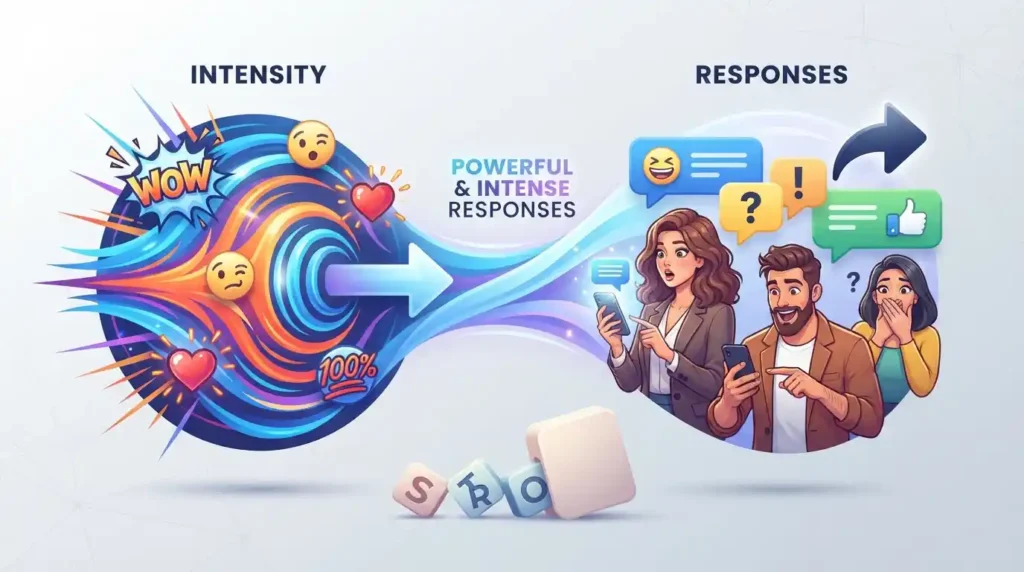
It is not an acronym or abbreviation with a full form. The phrase simply combines:
- Strong — intense, powerful, or significant
- Reactions — responses to something
Together, the phrase means powerful or intense responses.
How Is Strong Reactions Used?
Strong reactions can appear in many types of communication.

In Text Messages
People may use the phrase when discussing someone’s response to news, a conversation, or an event.
Example:
“That announcement got some strong reactions from everyone.”
In Group Chats
The phrase can describe how multiple people responded to something shared in the conversation.
Example:
“My picture got strong reactions in the group chat.”
On Social Media
People may use it to describe audience responses to posts, videos, opinions, or announcements.
Example:
“Her video is getting strong reactions online.”
In Comments and Discussions
It can also describe disagreement or emotional responses during a discussion.
Example:
“That opinion always gets strong reactions.”
Strong Reactions in Different Contexts
The meaning of strong reactions can change depending on what caused the response.
From a Friend
If a friend says something caused strong reactions, they may simply mean that people had intense opinions or emotions about it.
Example:
“That joke got strong reactions from our friends.”
The reactions could be laughter, surprise, disagreement, or another response.
In a Group Chat
In a group chat, strong reactions may refer to a lively response from several people.
Example:
“Sending that screenshot caused strong reactions in the chat.”
The phrase does not explain exactly what everyone felt, so the earlier messages provide important context.
On Social Media
On social media, strong reactions can refer to significant emotional responses in comments, replies, or discussions.
Example:
“The post received strong reactions from followers.”
Those reactions may be positive, negative, or divided.
In Dating or Relationships
In a relationship conversation, the phrase can describe an intense emotional response to something someone said or did.
However, strong reactions alone do not prove romantic interest, jealousy, anger, or attraction. The rest of the conversation matters.
Real Chat Examples
Here are some natural ways strong reactions can appear in conversation:
- “That announcement got some strong reactions.”
- “I didn’t expect the news to cause such strong reactions.”
- “Her post is getting strong reactions in the comments.”
- “The movie definitely brought out strong reactions.”
- “That opinion always gets strong reactions from people.”
- “My message got stronger reactions than I expected.”
- “There were some strong reactions in the group chat.”
- “That video caused strong reactions online.”
- “I knew people would have strong reactions to it.”
- “The ending got strong reactions from everyone.”
- “Wow, that story really brought out some strong reactions.”
- “People had strong reactions, but not everyone agreed.”
- “His comment received some pretty strong reactions.”
- “That topic tends to create strong reactions.”
- “I can understand why people had such strong reactions.”
- “The announcement sparked strong reactions from fans.”
- “There were strong reactions on both sides.”
- “I wasn’t trying to get such strong reactions.”
- “That picture got a lot of strong reactions.”
- “The conversation took a turn after those strong reactions.”
How to Reply to Strong Reactions
Your reply depends on what kind of reaction the other person is discussing.
Casual Replies
- “Yeah, I can see why.”
- “Honestly, I had a strong reaction too.”
- “That doesn’t surprise me.”
- “I wasn’t expecting that either.”
Friendly Replies
- “I get why people felt that way.”
- “That definitely gave everyone something to talk about.”
- “I can understand both sides.”
- “Sounds like it really got people’s attention.”
Funny Replies
- “Well, it definitely woke everyone up. 😂”
- “Guess people had feelings about that one. 😭”
- “And the comments section went wild. 😂”
- “That escalated quickly. 😅”
Neutral Replies
- “What kind of reactions did it get?”
- “How did people respond?”
- “Were the reactions mostly positive or negative?”
- “What do you think caused such a strong response?”
What Tone Does Strong Reactions Have?
Strong reactions is generally a neutral and descriptive phrase.
Depending on context, it can suggest:
- Surprise
- Excitement
- Disagreement
- Shock
- Anger
- Strong approval
- Concern
- Emotional intensity
The phrase itself does not identify a specific emotion. You need to look at what happened and how people responded.
Punctuation, emojis, wording, and the previous conversation can also help explain the intended tone.
Is Strong Reactions Rude or Offensive?
No. Strong reactions is not generally rude, offensive, or inappropriate.
It can be used in:
- Casual conversations
- Text messages
- Group chats
- Social media discussions
- School conversations
- Work discussions
However, the subject being discussed may be sensitive. In those situations, it is important to consider the overall wording and tone.
The phrase is also suitable for more formal communication because it is standard English rather than internet slang.
Other Meanings of Strong Reactions
The phrase can have a broader meaning outside texting and social media.
Strong Emotional Reactions
This is the most common general meaning. It describes intense feelings or emotional responses to an event, message, experience, or situation.
Strong Physical Reactions
In some contexts, strong reactions can describe noticeable physical responses, such as reactions to an experience or substance. The exact meaning depends on the subject being discussed.
Because the phrase is broad, context is especially important when determining its meaning.
Common Mistakes About Strong Reactions
Assuming It Is Text Slang
Strong reactions is not a standard texting abbreviation or acronym. It is an ordinary English phrase that can appear in texts and online conversations.
Assuming All Strong Reactions Are Negative
Strong reactions can be positive, negative, or mixed. Excitement and admiration can be just as strong as anger or disappointment.
Assuming the Exact Emotion
The phrase does not tell you whether someone felt happy, angry, shocked, or another emotion. Look at the surrounding conversation for clarification.
Assuming Relationship Intent
If someone mentions strong reactions during a conversation with a friend, crush, or partner, the phrase alone does not reveal romantic feelings or intentions.
Strong Reactions and Related Terms
| Term | Meaning | Common Use |
|---|---|---|
| Big reaction | A noticeable or intense response | Casual conversations |
| Overreaction | A response viewed as more intense than necessary | Arguments and discussions |
| Emotional response | A reaction involving feelings | General and formal communication |
| Mixed reactions | Different or divided responses | Reviews and social discussions |
| Strong response | A powerful or significant reaction | General communication |
People Also Ask About Strong Reactions
Is strong reactions a slang term?
No. Strong reactions is generally a standard English phrase rather than slang. It can still be used casually in texts, social media, and everyday conversations.
What does having a strong reaction mean?
Having a strong reaction means responding with intense emotion or another powerful response. The specific reaction could be positive, negative, or mixed.
Are strong reactions always negative?
No. Strong reactions are not automatically negative. People can have strong positive reactions, such as excitement, happiness, admiration, or surprise.
What is the difference between a reaction and a strong reaction?
A reaction is any response to something. A strong reaction is more intense, noticeable, or emotionally powerful.
What does strong reaction mean in a text message?
In a text message, it usually means someone responded intensely to something that was said, shared, or discussed. The surrounding messages are needed to determine the exact emotion.
Does strong reactions mean someone is angry?
Not necessarily. Anger can be a strong reaction, but so can excitement, shock, laughter, admiration, or concern.
Can strong reactions be used in professional communication?
Yes. Because it is a standard English phrase, it can be used in professional settings when appropriate. The tone and subject matter should match the situation.
Conclusion
Strong reactions means powerful or intense responses to something. It is not an acronym or texting abbreviation, and it can describe positive, negative, or mixed emotions depending on the context.
In texts, group chats, and social media, the phrase usually refers to a noticeable response from one person or many people. Its tone is generally neutral, and the surrounding conversation determines the exact meaning. It is also appropriate in casual, professional, and formal communication.

Emma Brooks is a writer focused on captions and quotes that capture experiences, emotions, and memorable moments. Her four and a half years of work include travel, lifestyle, relationship, event, social media, entertainment, and aesthetic themes. Emma analyzes tone, organizes caption concepts by context, and refines wording to create clear expressions suited to different occasions and visual styles.