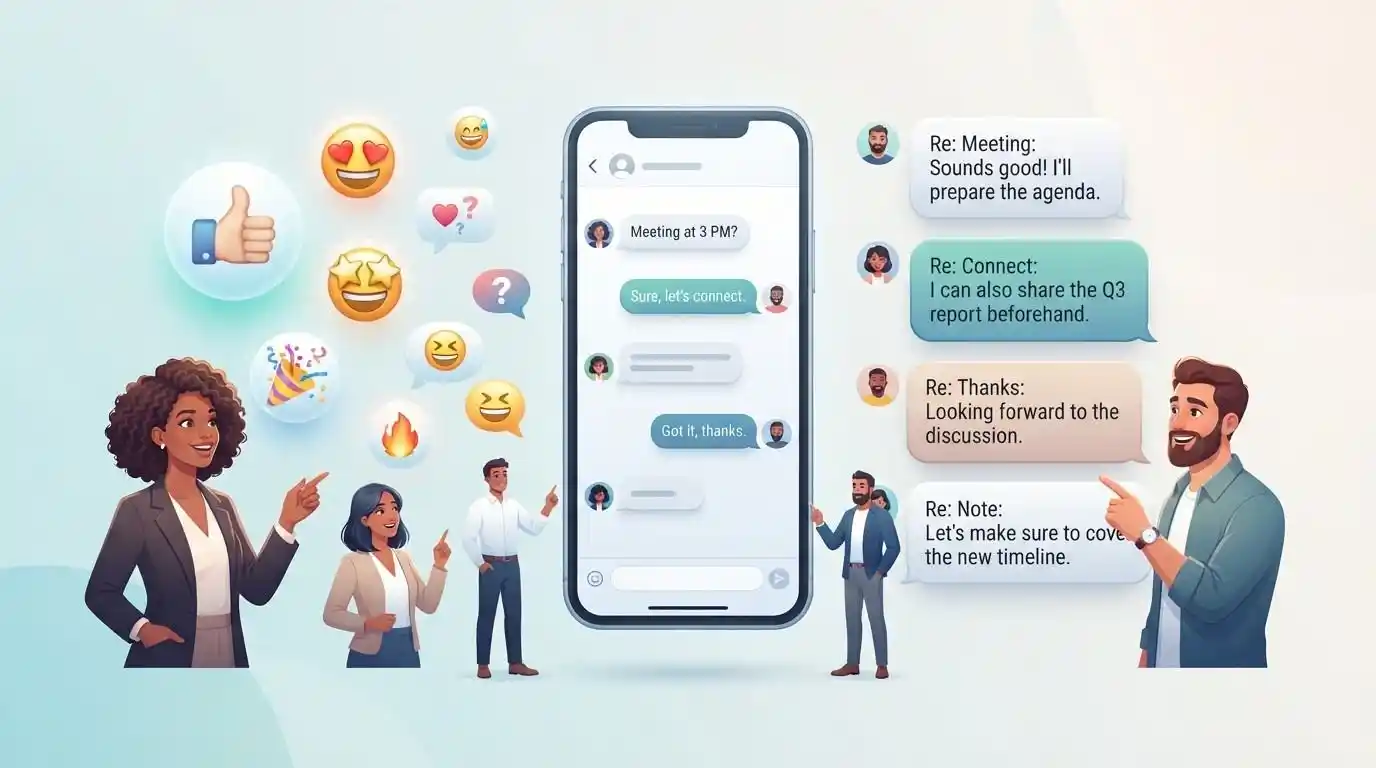
Reactions & Responses refers to the ways people react to something and communicate their reply, whether through words, emojis, GIFs, likes, comments, or other forms of online communication. The phrase is commonly used when discussing how someone responds to a message, post, event, or situation.
Key Takeaways
- Reactions usually show an immediate feeling or emotional response.
- Responses usually involve a more direct reply through words or actions.
- The phrase Reactions & Responses is not a traditional texting abbreviation or acronym.
- On social media, reactions can include emojis, likes, and other interactive features.
- The meaning can vary slightly depending on whether the phrase refers to texting, social media, or general communication.
- Context helps explain whether someone is expressing emotion, giving feedback, or replying directly.
Reactions & Responses Meaning in Text
In text and online communication, Reactions & Responses describes two connected ways people communicate after seeing or receiving something.
A reaction is often an immediate expression of how someone feels. It may be as simple as a laughing emoji, a heart, a thumbs-up, or a short message such as “Wow.”
A response, on the other hand, is usually a more direct reply. It answers, comments on, or continues the conversation.
For example:
- Reaction: 😂
- Response: “That was the funniest thing I’ve seen today.”
The phrase is not exactly internet slang. Instead, it is a general communication term that can apply to text messages, social media, comments, DMs, group chats, and online discussions.
The tone is usually neutral and context-dependent. The actual reaction or response determines whether the communication sounds friendly, funny, serious, supportive, sarcastic, or something else.
What Does Reactions & Responses Stand For?
Reactions & Responses does not have a fixed full form because it is not a traditional acronym or texting abbreviation.
It is simply a phrase made up of two related words:
- Reaction = an immediate emotional or expressive response to something
- Response = a reply, answer, or action given after something happens or is communicated
The phrase is often used together when discussing how people interact with messages, posts, situations, or other people.
How Are Reactions & Responses Used?
Reactions and responses can appear across many types of online communication.

In Text Messages
In texting, a reaction may be an emoji or a quick expression, while a response usually continues the conversation.
Example:
- “I passed my exam!”
- Reaction: 🎉
- Response: “That’s amazing! Congratulations!”
In DMs
Direct messages often include quick reactions to messages as well as written replies.
Someone might react with a heart to show appreciation and then send a message with more detail.
In Group Chats
Group chats can have many different reactions and responses to the same message.
One person might send a laughing emoji, another might reply with a joke, and someone else might ask a question.
On Social Media
Social media platforms commonly allow users to react through:
- Likes
- Hearts
- Emojis
- GIFs
- Comments
- Replies
A reaction can show quick engagement, while a response often adds a more detailed opinion or message.
In Online Comments
People may react emotionally to a post and then respond with their thoughts.
For example, someone might write:
“I can’t believe this happened 😭”
That message can function as both an emotional reaction and a written response.
Reactions & Responses in Different Contexts
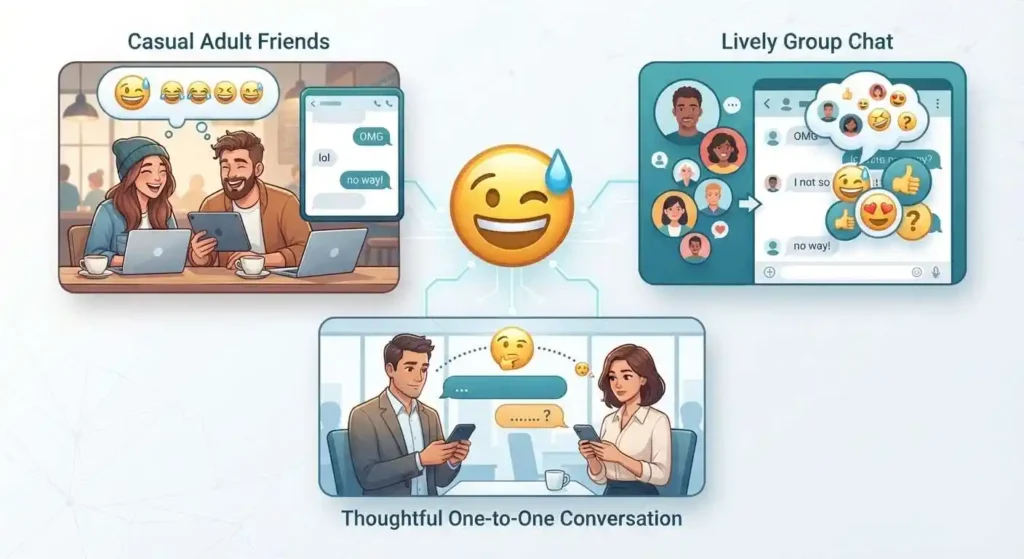
The meaning of a reaction or response depends heavily on context.
From a Friend
A friend’s reaction may show surprise, excitement, support, or humor. Their response may provide more detail about what they think.
For example, “OMG 😂” is a quick reaction, while “You seriously need to tell me the whole story” is a fuller response.
In a Group Chat
Group conversations often create mixed reactions. Different people may interpret the same message differently, so reactions and responses can vary.
On Social Media
A reaction may simply show engagement with content, while a comment or reply may communicate a stronger opinion or start a conversation.
In a Relationship or Dating Conversation
Reactions and responses can sometimes feel more meaningful because of the relationship between the people involved. However, a single emoji, reaction, or short reply does not automatically prove romantic interest or a particular feeling.
Look at the broader conversation, previous messages, wording, and relationship between the people involved.
Real Chat Examples
Here are realistic examples of reactions and responses in everyday online communication:
- Message: “I got the job!”
Reaction: 🎉
Response: “No way! Congrats, that’s awesome!” - Message: “I accidentally sent that to the wrong person.”
Reaction: 😂
Response: “Oh no! What happened after that?” - Message: “Guess who’s coming to town this weekend?”
Reaction: 👀
Response: “Okay, now you have to tell me.” - Message: “I finally finished the project.”
Reaction: 🙌
Response: “You did it! That took forever.” - Message: “I’m so tired today.”
Reaction: 😭
Response: “Same. I need a nap already.” - Message: “Look at this picture.”
Reaction: ❤️
Response: “This is such a great photo!” - Message: “I have some news.”
Reaction: 😳
Response: “Wait, what happened?” - Message: “The test was harder than I expected.”
Reaction: 😬
Response: “I felt the same way.” - Message: “We won!”
Reaction: 🔥
Response: “Let’s go! That game was incredible.” - Message: “I made dinner for everyone.”
Reaction: 👏
Response: “That looks delicious!” - Message: “I can’t stop laughing at this.”
Reaction: 😂😂
Response: “Send it to me right now.” - Message: “I’m moving next month.”
Reaction: 😮
Response: “Wow, where are you moving?” - Message: “I forgot my password again.”
Reaction: 🤦
Response: “How does that keep happening?” - Message: “Today has been wild.”
Reaction: 😭
Response: “Okay, I need the full story.” - Message: “Thanks for helping me.”
Reaction: ❤️
Response: “Of course! Happy to help.” - Message: “I just watched the finale.”
Reaction: 😱
Response: “Don’t spoil it! I haven’t seen it yet.” - Message: “Should we go out later?”
Reaction: 👍
Response: “Yeah, I’m free after six.” - Message: “I changed my hair.”
Reaction: 😍
Response: “It looks great!” - Message: “That meeting could have been an email.”
Reaction: 💯
Response: “Honestly, completely agree.” - Message: “I’m not sure what to do.”
Reaction: 🤔
Response: “Let’s think it through together.”
How to Reply to Reactions & Responses
There is no single reply to Reactions & Responses because the phrase describes a type of interaction rather than a specific piece of slang.
Your reply should depend on what the other person actually reacted to or said.
Casual Replies
- “Haha, I know right?”
- “Exactly!”
- “That was my reaction too.”
- “I figured you’d say that.”
- “Fair enough 😂”
Friendly Replies
- “I’m glad you liked it!”
- “Thanks for the reaction!”
- “That made me laugh too.”
- “I appreciate your response.”
- “Glad we’re on the same page.”
Funny Replies
- “The reaction says it all 😂”
- “No words were needed.”
- “That response was completely expected.”
- “Honestly, I had the same reaction.”
- “I’m going to take that as approval.”
Neutral Replies
- “Thanks for letting me know.”
- “That makes sense.”
- “I understand your response.”
- “Good point.”
- “I appreciate the feedback.”
What Tone Does Reactions & Responses Have?
The phrase Reactions & Responses itself usually has a neutral tone.
The tone comes from the actual reaction or response being discussed.
For example:
- 😂 can suggest amusement
- ❤️ can suggest appreciation or affection
- 👍 can suggest agreement or acknowledgment
- 😳 can suggest surprise
- “Okay.” can sound neutral, direct, or dismissive depending on context
Because online communication lacks some face-to-face cues, it is important to consider:
- The words used
- Punctuation
- Emojis
- Previous messages
- The topic of the conversation
- The relationship between the people communicating
A reaction should not be interpreted by itself when the larger conversation provides important context.
Is Reactions & Responses Rude or Offensive?
No, the phrase Reactions & Responses is not rude or offensive by itself.
It is a neutral phrase used to describe communication and interaction.
However, individual reactions and responses can have very different tones.
Casual Conversations
The phrase and most reactions are appropriate in casual communication. Emojis, GIFs, and short replies are common ways to communicate quickly.
Friends and Social Media
Reactions and responses are a normal part of online interaction. The meaning depends on the specific message or symbol used.
School and Work
Written responses are generally more appropriate when clear communication is needed. Quick reactions may work in informal team chats, but they may not provide enough detail in professional situations.
Formal Writing
The phrase may be used when discussing feedback, communication, or audience interaction, but emojis and casual reaction features are usually less suitable in formal writing.
Other Meanings of Reactions & Responses
The phrase can also appear outside texting and social media.
In General Communication
Reactions and responses can describe how a person responds emotionally or verbally to an event, idea, or situation.
For example:
“The audience’s reactions and responses were positive.”
Here, reactions may refer to immediate feelings or behavior, while responses may refer to more deliberate feedback or communication.
In Feedback and Discussion
The phrase can also describe how people respond to content, announcements, products, news, or presentations.
For example:
“The team reviewed customer reactions and responses.”
In this context, the phrase refers broadly to feedback and audience engagement rather than texting slang.
Common Mistakes About Reactions & Responses
Thinking They Mean Exactly the Same Thing
The words are closely related, but they are not always identical. A reaction is often more immediate, while a response can be more deliberate or detailed.
Assuming an Emoji Explains Everything
An emoji reaction can have different meanings depending on the conversation and relationship between the people involved.
Overreading Romantic Intent
A heart, smile, or other positive reaction does not automatically confirm flirting or romantic interest. Context matters.
Treating a Reaction as a Full Reply
A quick reaction may acknowledge a message without answering a question or continuing the conversation.
Ignoring the Conversation Around It
A reaction or response can be misunderstood when viewed without the messages that came before it.
Reactions & Responses and Related Terms
| Term | Meaning | Common Use |
|---|---|---|
| Reply | A direct answer to a message or comment | Texts, emails, comments |
| Reaction | An immediate emotional or expressive response | Social media, messaging |
| Response | A reply or answer to something | General communication |
| Feedback | Opinions or comments about something | Work, school, products |
| Comment | A written opinion or reaction | Social media and discussions |
| Emoji reaction | A quick response using an emoji | Messaging and social platforms |
People Also Ask About Reactions & Responses
What is the difference between a reaction and a response?
A reaction is often an immediate expression of emotion or feeling, while a response is usually a more direct answer or reply. In online communication, an emoji can be a reaction, while a written message can be a response.
Are reactions and replies the same thing?
Not always. A reaction can acknowledge or express a feeling about a message without adding new words, while a reply usually communicates a direct response.
What does it mean when someone reacts to your message?
It usually means they want to acknowledge or respond to what you said quickly. The specific meaning depends on the reaction used and the surrounding conversation.
Is a reaction considered a response?
Yes, in a broad sense, a reaction is a type of response. However, in everyday messaging, people often use the word “response” to mean a more direct written or spoken reply.
Why do people react instead of replying?
A reaction is faster and can communicate agreement, amusement, appreciation, or acknowledgment without requiring a full message. It may also show that someone saw a message even if they do not have much to add.
Can an emoji reaction be misunderstood?
Yes. Emojis can have different meanings depending on tone, context, and the relationship between the people involved. Looking at the full conversation can help prevent misunderstandings.
Conclusion
Reactions & Responses refers to the different ways people respond to messages, posts, events, and situations. A reaction is often a quick expression of feeling, while a response is usually a more direct reply.
The phrase is not a traditional acronym or texting abbreviation, and its meaning is generally neutral. Whether an interaction sounds funny, friendly, serious, supportive, or sarcastic depends on the actual words, emojis, and context involved. In texting and social media, understanding the full conversation is the best way to interpret someone’s reaction or response accurately.

Emma Brooks is a writer focused on captions and quotes that capture experiences, emotions, and memorable moments. Her four and a half years of work include travel, lifestyle, relationship, event, social media, entertainment, and aesthetic themes. Emma analyzes tone, organizes caption concepts by context, and refines wording to create clear expressions suited to different occasions and visual styles.